Showing posts with label Madeleine L'Engle. Show all posts

Monday, June 28, 2010

Mentor Monday: The Whens

I know writers who write only when inspiration comes.  How would Isaac Stern play if he played the violin only when he felt like it?  He would be lousy . . . the same is true for art of every type. 

                                      -- Madeleine L'Engle


I write only when I feel like it and whenever I feel like it.  I do it in a restaurant, on a plane, on a train in a car.  I wake up in the middle of the night to make notes to myself and never know when I'll sit down at the typewriter -- or the tape recorder.  The new book stays with me all the time . . . I think the longest uninterrupted stretch I ever had was twenty-seven hours.  I produced nineteen pages of the Painted Bird, which in the drafts that followed shrank to one page.  On an average, I probably produce about a page, maybe a page and a half, in a sitting.

                                         -- Jerzy Kosinski


In this profession you have to write something every day, because language is hard to control . . . You have to work five hours a day, even if you just describe what your milk dealer says.

                                          -- Use Johnson


Every morning between 9 and 12, I go to my room and sit before a piece of paper.  Many times, I just sit for three hours with no ideas coming to me.  But I know one thing: If an idea does come between 9 and 12 I am there ready for it.

               -- Flannery O'Connor


When I sit down to write -- that's between nine and twelve every morning, and I have never incidentally, written a line in the afternoon or night -- when I sit down at my table to write, I never know what it's going to be till I'm underway.  I trust in inspiration, which sometimes comes and sometimes doesn't.  But I don't sit back waiting for it.  I work every day.

                          -- Alberto Moravia


Perhaps it would be better not to be a writer, but if you must, then write.  You feel dull, you have a headache, nobody loves you, write.  If all feels hopeless, if that famous 'inspiration' will not come, write.  If you are a genius, you'll make your own rules, but if not -- and the odds are clearly against it -- go to your desk, no matter what your mood, face the very challenge of the paper -- write.

                              -- J. B. Priestley

Wednesday, March 24, 2010

Women of Wednesday: Two Newbery Winners


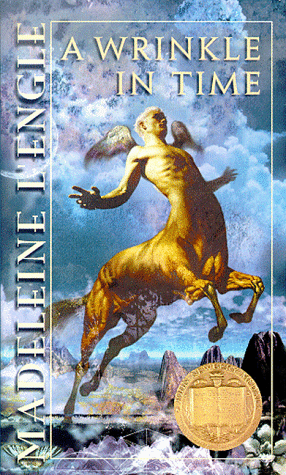
“Madeleine L’Engle throws her hands up in the gesture that says ‘Who knows?’ when a visitor asks how many rejections she received for her award-winning book, A Wrinkle in Time.
‘There were over 30,’ she says, ‘It almost never got published. People think it was my first book, but it was the 11th to be written. I call it my “Cinderella book.” You name any major publisher in New York, and they rejected it.’
No on really expected it to sell, she confesses but ‘it really took off.’ It won a Newbery medal in1963, is in its 39th printing…and has come to be considered a children’s classic.” Jean Caldwell, p. 74, On Being a Writer, Writer’s Digest Books, 1989.


This is the story many children’s book writers cling to when the latest rejection letter comes in. A Wrinkle in Time is a wonderful book, and like all of our wonderful books, it just needed to find that special editor who would recognize its wonderfulness.

The most recent Newbery winner is Rebecca Stead who pays homage to L’Engle’s book in her own When You Reach Me. Stead’s book is also a fantasy and a time travel book. The main character, Mira, clings to A Wrinkle in Time. It’s her favorite book and she reads it over and over.

Both L’Engle and Stead wait awhile to let their readers in on the fact that the books are fantasy. L’Engle starts out with enough creepy description that one thinks they may have stumbled onto a ghost story. Those who love pop culture will get the joke in the L’Engle’s opening line as either the one often used by Snoopy in the Peanuts © cartoon strip or as the basis for San Jose State Univeristy’s annual Bulwer-Lytton Fiction Contest that seeks examples of overly dramatic fiction:

“It was a dark and stormy night.
In her attic bedroom Margaret Murry, wrapped in an old patchwork quilt, sat on the foot of her bed and watched the trees tossing in the frenzied lashing of the wind. Behind the trees clouds scudded frantically across the sky. Every few moments the moon ripped through them creating wraith-like shadows that raced along the ground.”

Stead’s novel, set in the 70’s, opens like any typical pre-teen story with a girl, a single mom, a challenge, and soon, we learn, a friendship that is ending:

“So Mom got the postcard today. It says Congratulations in big curly letters, and at the very top is the address of Studio TV-15 on West 58th Street. After three years of trying, she has actually made it. She’s going to be a contestant on the $20,00 Pyramid, which is hosted by Dick Clark.”
Both stories quickly lead us into the bigger problems faced by the main characters. Meg’s father is missing. Mira’s been getting mysterious and cryptic notes: “I am coming to save your friend’s life, and my own…” Time travel will solve both problems.

Both authors have created flawed, believable characters. The impossibilities that create the plots become possible in our minds. Good writers can do that. If you don’t usually make a habit of reading the Newbery authors, start with these two. Get to know a couple of good writers.