
Wednesday, March 24, 2010

Women of Wednesday: Two Newbery Winners


“Madeleine L’Engle throws her hands up in the gesture that says ‘Who knows?’ when a visitor asks how many rejections she received for her award-winning book, A Wrinkle in Time.
‘There were over 30,’ she says, ‘It almost never got published. People think it was my first book, but it was the 11th to be written. I call it my “Cinderella book.” You name any major publisher in New York, and they rejected it.’
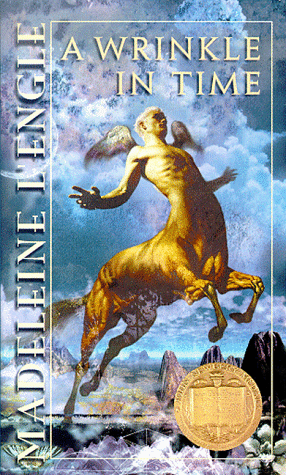
No on really expected it to sell, she confesses but ‘it really took off.’ It won a Newbery medal in1963, is in its 39th printing…and has come to be considered a children’s classic.” Jean Caldwell, p. 74, On Being a Writer, Writer’s Digest Books, 1989.


This is the story many children’s book writers cling to when the latest rejection letter comes in. A Wrinkle in Time is a wonderful book, and like all of our wonderful books, it just needed to find that special editor who would recognize its wonderfulness.

The most recent Newbery winner is Rebecca Stead who pays homage to L’Engle’s book in her own When You Reach Me. Stead’s book is also a fantasy and a time travel book. The main character, Mira, clings to A Wrinkle in Time. It’s her favorite book and she reads it over and over.

Both L’Engle and Stead wait awhile to let their readers in on the fact that the books are fantasy. L’Engle starts out with enough creepy description that one thinks they may have stumbled onto a ghost story. Those who love pop culture will get the joke in the L’Engle’s opening line as either the one often used by Snoopy in the Peanuts © cartoon strip or as the basis for San Jose State Univeristy’s annual Bulwer-Lytton Fiction Contest that seeks examples of overly dramatic fiction:

“It was a dark and stormy night.
In her attic bedroom Margaret Murry, wrapped in an old patchwork quilt, sat on the foot of her bed and watched the trees tossing in the frenzied lashing of the wind. Behind the trees clouds scudded frantically across the sky. Every few moments the moon ripped through them creating wraith-like shadows that raced along the ground.”

Stead’s novel, set in the 70’s, opens like any typical pre-teen story with a girl, a single mom, a challenge, and soon, we learn, a friendship that is ending:

“So Mom got the postcard today. It says Congratulations in big curly letters, and at the very top is the address of Studio TV-15 on West 58th Street. After three years of trying, she has actually made it. She’s going to be a contestant on the $20,00 Pyramid, which is hosted by Dick Clark.”
Both stories quickly lead us into the bigger problems faced by the main characters. Meg’s father is missing. Mira’s been getting mysterious and cryptic notes: “I am coming to save your friend’s life, and my own…” Time travel will solve both problems.

Both authors have created flawed, believable characters. The impossibilities that create the plots become possible in our minds. Good writers can do that. If you don’t usually make a habit of reading the Newbery authors, start with these two. Get to know a couple of good writers.

Monday, March 22, 2010

PERCEPTION IS BASED ON EXPERIENCE

Writing for children is like writing for adults—only harder.

People who have never tried to write for kids don’t “get” that statement. In fact, many children’s writers will tell you that they have been asked, at one time or another, if they think they will ever write a real (read adult) book.

Like adult literature, a good children’s book is marked by an interesting plot, fascinating characters, and enough tension to keep the pages turning. However, a writer for children must also pay attention to extra aspects when creating a story. We think about our intended audience in order to determine how easily they will absorb the tale. This ability is going to be based on the child’s level of reading skill and more importantly, his or her age. For most children, their age will tell us a little bit about their life experiences and their life experiences will color their perception of a story.

Here’s an example from my own life:

I'm about age four or five. I’m standing in the kitchen with my mother. She leans down to tuck my t-shirt into my pants. As she does so, the scoop neckline of her dress opens enough so that I can see something terrible: a hole! My mother has a long, dark hole in her chest! I experience an onslaught of emotions such as fear, curiosity, and amazingly, sympathy. I feel so bad for my mom. She has to live with that hole in her chest! It’s no wonder that she’s never mentioned it. She’s probably embarrassed. Well, I decide, I’m not going to make it worse for her. I will NEVER mention the terrible chest hole to anyone. I will keep her secret. I will not even ask her about it, because I don’t want to hurt her feelings. I am old enough to understand about hurt feelings.

What I don’t understand at that age is cleavage. Women in those days did not flaunt it. My mom is a pretty small woman. I’ve never paid attention to the shape of her body. My grandmothers—who were full-figured ladies—had big bosoms. But I don’t know bosoms. I know fat people. Some were fat on top (like my grandmas) and some were fat in the middle (like my grandpas). At that age, my life experience was limited to my ability to be observant. At age four or five, all you care to observe is what impacts you directly: toys, friends, food, love, comfort, feeling safe.

While such an example probably wouldn’t occur in today’s more open society, it serves to show that kids’ stories need to start where they are in life experience. Innocence has to do with the lack of life experience.

Books help kids to grow intellectually, too, but they are not going to succeed if stories start beyond the young reader’s ability to relate. There’s a reason the only kisses in a toddler book are from mommy or daddy. There’s a reason today’s 12-and-13-year olds consider phone texting as “going out” with someone. There’s a reason no book incorporating the U.S. tax code will ever win a Newbery Medal. Reality for a child Is not the same as adult reality.

As you write your story, think about the reader’s perception. Who is your audience? What will they get out of the story?

Friday, March 19, 2010

Poetry Friday--Knock on Wood


Knock on Wood: Poems about Superstitions by Janet S. Wong, illustrated by Julie Paschkis (Margaret K. McElderry Books, 2003) is an interesting volume. The poems and superstitions cover cats, garlic, hats, potatoes, salt and wood and 11 more. At the end, Wong includes brief explanations of each of the superstitions, and her author's note explains how her interest in the subject developed. She also mentions a reference work for anyone who is interested in further study of superstition.

Here's her poem called "Hair":
Eat the crust of fresh baked bread
for curly hair upon your head--

brush, don't comb, your hair at night,
and you won't hear a nasty fight--

Tuesday is your haircut day
if you want your luck to stay--

stand bareheaded in the rain
to cure a baldness in the brain.

Julie Paschkis's watercolor magical illustrations include people of many races and ethnicities. This would be a fabulous book for classroom use--for example, as a creative writing exercise, have the child pick a couplet from the poem above and write a story or poem inspired by that aspect of hair superstition.

This week's Poetry Friday Round-Up is found at Some Novel Ideas.

Wednesday, March 17, 2010

Women of Wednesday--Long Live(d) New Hampshire Women

Last week Barbara wrote a tribute to Granny D who passed away at 100 years of age. On March 7, New Hampshire also lost Mary Josephine Ray. At the time of her death, Mrs. Ray was 114 years old! Actually she was closer to 115 since her birthday was coming up in two months. Mary Josephine Ray was born May 17, 1895 on Prince Edward Island in Canada and later moved in New Hampshire.

A brief news report states that Ray "was born before Henry Ford built his first car or Marconi patented the radio." To be specific, Mrs. Ray was born one year before Marconi patented his radio and Henry Ford built his "Quadricycle" in 1896. It would be another 12 years before Ford produced the Model T and revolutionized the automobile industry.

On the day of her birth, The New York Times had on its front page this headline: "FATE OF THE INCOME TAX; Believed in Washington that It Will Be Killed Monday." Income tax is one of those things that people propose eliminating. It ain't happened yet! But, think about this--how much would a person have contributed in taxes over 114 years?

In 1895 there were 44 states in the U.S. The 45th, Utah, was admitted when Mrs. Ray was not quite 8 months old. At the time of her birth, Hawaii was in the midst of political upheaval, and its citizenry opposed its annexation to the U.S. When Ray was 64, Hawaii became our 50th state and the birthplace of a future president--our first black president!

I wonder if anyone in 1895, or even 1959, thought that a black man would ever be president. Certainly in 1895 areas of the U.S. was vehemently against that coming to pass. The New York Times reported in May 1895 of a proclamation issued by the governor of South Carolina. In it Gov. Evans called for a state Constitutional convention in which "a Constitution is to be made guaranteeing white supremacy once and forever." I'm sure Evans thought white supremacy should have been guaranteed everywhere in the U.S., not just S.C. This way of thinking still exists today in the minds of some people. We've come a long way in 114 years, but we need to keep moving toward equality for all.

It was fun to read that Mary Josephine Ray was a Boston Red Sox fan, and it's amazing to think that from the time she was 17 to the time she was 23, the Sox won the World Series 4 times. Ray had to go 86 years before the Sox won again. She was 99!

The 1912 World Series winning Red Sox

In 1890, the life expectancy for a white woman was 44.46 years. By 1900 it had increased to 51.08. In 2000 it was 80.0 years. Against all odds, Mary Josephine Ray lived for 114 years. Was it something in the New Hampshire air? I don't know, but I do know that I'm breathing deeply and looking forward to what happens if I live another 54 years!

--Diane

Monday, March 15, 2010

Mentor Monday--In the Mood

"In the Mood" was one of the songs I listened to when I was working on a World War II project. Several of the other songs I grew fond of while researching and writing that book were "Praise the Lord and Pass the Ammunition," "Polka Dots and Moonbeams," "We'll Meet Again," and "The Last Call for Love."

Listening to music being played during the period I was writing about not only helped to put me in the mood to write, it also gave me a connection to the people who lived then. I could imagine how the words to a song like "Don't Sit Under the Apple Tree," reminded a young woman of the promises her soldier boy had made to her before shipping off. And, the ache she must have felt was, for me, nearly tangible.

You can find music all over the internet--I'm sure I don't have to tell you about YouTube!


The Internet Archive's Audio Archive is a treasure trove with hundreds of thousands of items!Duke University has a vast collection of sheet music that'll take you back to the early 1900s (and further) if that's the era you're writing about. Or, go to your local public library and browse through its collection of CDs. Look at the music section for books covering the time period you are writing about, even if you can't read music, you can get a feeling for the time by reading the lyrics and absorbing the language. In the library I work in, we have books such as Civil War Songs, and Singing the New Nation: How Music Shaped the Confederacy, 1861-1865 that would be useful with a Civil War project.

Have fun!

--Diane